


Head of the Union of Industrialists and Entrepreneurs of Armenia named promising areas for Armenian-Turkish business after the border opened
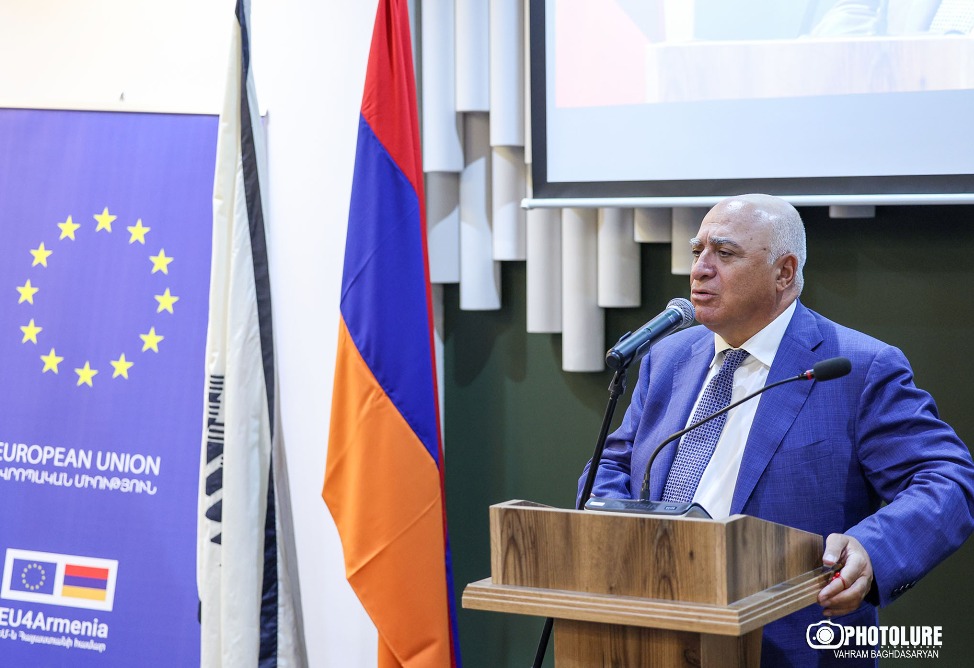
YEREVAN, September 3. /ARKA/. The opening of the Armenian-Turkish border could create new opportunities for trade, joint investment, tourism, agriculture, and the construction sector. This was stated by Arsen Ghazaryan, Chairman of the Union of Industrialists and Entrepreneurs of Armenia (UIEA), speaking at the Armenian-Turkish business forum in Yerevan.
The two-day Armenian-Turkish business forum, organized by the Union of Industrialists and Entrepreneurs of Armenia (UIEA), is taking place in Yerevan.
"Today, the situation is changing. We again expect the [Armenian-Turkish - ed.] border to open soon. We've been saying 'soon' for 33 years, but we hope that now the border will truly open," Ghazaryan said.
According to him, despite the lack of diplomatic relations between Armenia and Turkey, entrepreneurs from the two countries have maintained business ties for decades.
"Over all these years, despite the lack of diplomatic relations, state support, and business protection, there have been no serious incidents between Armenian and Turkish entrepreneurs. They worked together normally and continued to develop their business interests," Ghazaryan noted.
He noted that Turkish goods and services have been entering the Armenian market since 1993, and trade volume has reached several hundred million dollars. However, opportunities for supplying Armenian products to Turkey were significantly limited, and exports were made in small quantities, primarily through third countries.
Ghazaryan emphasized that opening the border will significantly reduce transportation costs and delivery times, especially for businesses in border regions.
"When you're only 200-300 km apart, the speed of delivery, reduced transportation costs, flexibility, and the ability to do business with your neighbor create a completely different business environment," he said.
From Agriculture to Medical Tourism
Ghazaryan noted that the parties are currently exploring the potential for cooperation, primarily between border regions.
"This isn't Istanbul or Bursa; it's a specific region—Van, Iğdır, Diyarbakır. This is a specific market where there is demand for certain goods and services from our side," he said.
The head of the Union of Armenian and Turkish Healthcare Professionals (USAP) considers medical tourism from Turkey to Armenia to be one of the promising areas.
"It's absolutely clear to me that medical tourism from Turkey to Armenia will grow, as the healthcare system in these Turkish regions doesn't fully meet the needs of the population," Ghazaryan stated.
He also noted potential for joint business in agriculture. In particular, Armenian and Turkish entrepreneurs could collaborate in the production, processing, and packaging of agricultural products, with subsequent expansion into Eurasian and European markets.
"Today, Europe offers us preferential treatment." "If a Turkish entrepreneur comes and invests with an Armenian farmer, sets up production and processing, there could be potential," he said.
As an example, Ghazaryan cited the export of Armenian flowers to Turkey, which began after a business meeting in Kars about two months ago, without specifying specific volumes.
"Who could have believed, for example, that flowers would be exported from Armenia to Turkey? After the first business meeting in Kars, some of our entrepreneurs began exporting flowers there. I myself would never have thought of this before. Business is very flexible and capable of finding solutions," he noted.
Investments and Construction
Ghazaryan also sees opportunities for Turkish investors to come to Armenia after further normalization of relations.
According to him, direct investment ties have been limited until now, and third countries have had to be used to implement such projects.
"After establishing diplomatic relations, we will be able to jointly implement investment projects," he said.
Responding to a question about Turkish business interest in Armenia's construction sector, the head of the Union of Turkish Construction Industry (USPA) noted the high level of development of the construction industry, construction materials production, and development in Turkey.
"Naturally, they will want to enter our market. But we are quite developed ourselves, and our market is also very saturated," said Ghazaryan.
According to him, one option could be joint projects between Turkish investors and Armenian developers.
"It's possible that they will implement joint projects with Armenian developers," he noted.
Ghazaryan emphasized that the Armenian side is open to such cooperation.
"We've always said: welcome, come, work, let's do business together. On the Armenian side, there have never been any governmental, legal, or cultural barriers to such a business. There were barriers on the Turkish side. Now we expect them to be removed," he stated.
According to the head of the Union of Armenian Businessmen (UAB), simplification of trade procedures can already yield significant savings for businesses: in some cases, this could amount to approximately $500–$800 per truck.
Tourism and Cross-Border Relations
Ghazaryan believes tourism is another promising area.
"I am confident that there will be a constant flow of tourists from Armenia to Van, because there are historical, cultural, and psychological ties," he said.
According to the head of the Union of Armenian Businessmen (UAB), opening the border is especially important for entrepreneurs in Van, Igdir, and Kars, as direct travel will significantly shorten the journey to Armenia.
He noted that business communities should already be preparing for the possible opening of the border, establishing contacts, and seeking potential partners.
"We must be prepared to make up for the lost time of more than 30 years and learn to conduct business together," Ghazaryan emphasized.
The head of the Union of Armenian Businessmen (UAB) noted that the final list of the most promising areas of cooperation will be determined through the work of entrepreneurs from both countries.
"The potential is huge. But it's only through actual work that we'll gradually understand which areas are effective and which are pointless," said Ghazaryan.
According to him, the main criterion for business cooperation should be a concrete economic result.
"I'm a businessman and I want to see concrete results—profit and efficiency. This is what should form the basis of future relations," the chairman of the Union of Independent Trade Unions (USPA) stated.
About the meeting in Kars
On June 2, 2026, a meeting of business representatives from Armenia and Turkey took place in Kars, Turkey, as part of the normalization process between the two countries and with the support of the governments of Armenia and Turkey.
It was attended by Armenian and Turkish entrepreneurs from a range of sectors, including food and beverage production, construction, tourism, and floriculture. The parties discussed prospects for developing trade and economic cooperation.
According to the Public Radio of Armenia, the meeting participants welcomed Turkey's completion of administrative procedures allowing it to indicate Armenia or Turkey as the country of origin or destination for goods shipped through third countries. Access for Armenian goods to the Akhalkalaki (Georgia)–Kars (Turkey) railway line was also discussed.