


From Google Rankings to AI Trust: How Armenian Brands and Media Can Get In ChatGPT, Gemini, and Claude's Answers
27.07.2026,
16:32
Until recently, search results were the main battleground in the digital environment.
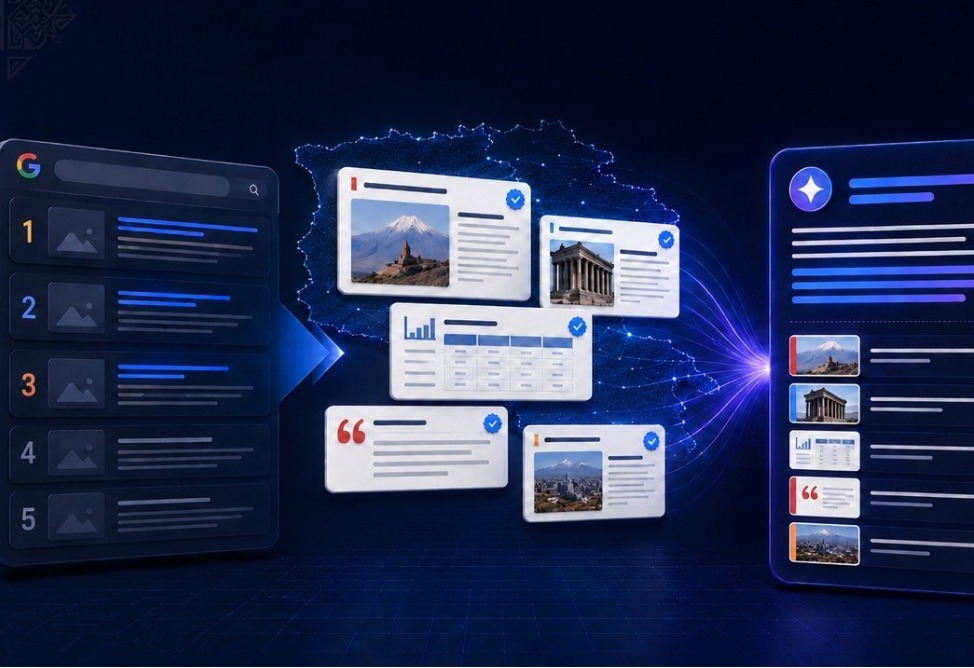
YEREVAN, July 27. /ARKA/. Until recently, search results were the main battleground in the digital environment. Companies invested in SEO, striving to reach Google's top ten, and fighting for every click. Today, more and more users are turning directly to generative artificial intelligence (GI) services—ChatGPT, Gemini, Claude, Perplexity, Google AI Overviews, and other services. Instead of a list of links, they receive a ready-made answer with recommendations, comparisons, conclusions, and a limited number of sources.
This doesn't mean that traditional search is losing its importance. Google remains the largest source of internet traffic, and SEO is one of the most important digital marketing tools. But alongside the traditional search model, a new ecosystem is emerging, where the key is no longer a site's position in search results, but the likelihood that AI will select that particular source.
Therefore, not only information search is changing, but also the principles of PR, content marketing, corporate communications, and the media itself.
From SEO to AI Visibility
The emergence of generative AI has created a new field known as AI Visibility, Generative Engine Optimization (GEO), or Answer Engine Optimization (AEO). While there's no unified terminology yet, the essence is the same: while SEO helps a website stand out in search results, AI Visibility increases the likelihood that AI will perceive a company, brand, or media outlet as a reliable source and use it when generating a response.
While traditional search offers the user a list of links, generative AI often immediately produces a synthesized response, independently determining which sources, facts, and organizations are worth mentioning.
This is creating a new kind of digital reputation: the sources the model favors increasingly determines which companies and media outlets will be noticed by the audience. Competition is gradually shifting from a struggle for rankings and clicks to a fight for the trust of not only people but also algorithms.
This topic already has practical implications. According to EMARKETER's forecast, by 2026, approximately 31.3% of the US population will use generative AI as a search tool. According to research by Responsive, approximately 80% of B2B technology buyers already use it when searching for suppliers, comparing products, and preparing purchasing decisions.
This doesn't mean the abandonment of traditional search, but rather a shift in information consumption patterns: for many companies, AI is no longer an experiment, but rather an integral part of the selection process. At the same time, platforms are emerging that track brand mentions in responses from ChatGPT, Gemini, Claude, Perplexity, and other systems and compare their visibility with competitors. What was an experiment just a few years ago is becoming a distinct area of marketing analytics.
At the same time, AI Visibility cannot yet be considered a fully formed discipline. There are no unified standards, model developers rarely disclose their source selection principles, and large language models themselves remain largely a "black box": companies can increase the likelihood of their presence in AI responses, but they don't fully control this process. Therefore, the most sustainable strategy is one based on content quality, expertise, transparency, and reputation, rather than on searching for universal technical techniques.
It's a mistake to contrast SEO with AI Visibility. A high-quality website, technical optimization, a logical structure, correct indexing, and strong expert content remain the foundation of a digital presence. AI Visibility is more of a complement to SEO: in addition to the goal of appearing in search results, it also aims to become a source trusted by AI to generate a response.
As a result, investments in high-quality content, professional journalism, expert publications, and brand reputation acquire additional value: they work not only for today's readers but also for the algorithms that increasingly determine which sources the audience will see.
How AI generates responses—and why they are less predictable
It's important to distinguish between two mechanisms. The first is related to the model's existing knowledge: its training set reflects the long-term presence of brands, organizations, and media outlets in the public sphere. If a source has regularly published high-quality content, been widely cited, and is perceived as authoritative, the likelihood of its presence in the model's knowledge is higher. The second mechanism is relevant web search, in which the system analyzes the current digital environment.
Therefore, a sustainable presence in AI responses is determined by both long-term reputation and the current quality of the digital presence.
For PR, this means that systematic work to build expertise and trust is more important than one-off campaigns. At the same time, the generative response is formed anew and depends on the model, the algorithm version, the availability of external search, and the interpretation of the question.
According to EMARKETER analysts, the composition of sources can change significantly after updates; research also shows that the share of cited resources for a single query changes over weeks or months. Therefore, AI Visibility cannot be considered a static value.
New Sources of Digital Authority
Generative models have expanded the range of sources they use. In addition to corporate websites and professional media, they now turn to Reddit, LinkedIn, YouTube, GitHub, technical documentation, professional forums, and open knowledge bases, which often contain relevant practical knowledge and expert discussions.
This isn't just due to the popularity of these platforms: they publish answers to specialized questions rarely covered in traditional news coverage. For businesses, this expands the very concept of digital presence: authority is built not only by one's own website and media publications, but also by the participation of experts in professional communities, research, open methodologies, and analytics.
The media economy is changing faster than expected
Generative AI has the most serious implications for professional media. The economic model of digital journalism has historically been built around traffic: editorial teams attracted audiences and monetized traffic through advertising, subscriptions, and partnerships.
If a user receives an answer through an AI interface, the need to visit the website is reduced, although journalistic content continues to serve as the basis for the answer. The value of the content remains, but the connection between citations and traffic is becoming less direct.
According to Similarweb, large international editorial offices, including Reuters and The Guardian, are already experiencing the fact that their content actively uses generative systems, while traffic from these services remains insignificant compared to search traffic.
Journalism isn't losing its value; the form of its capitalization is changing. Editorial reputation is becoming an independent asset, and media outlets are competing for both reader attention and the trust of algorithms.
The Armenian Case: What Generative AI Responses Reveal
To test the concept in practice, in July 2026, we studied the responses of ChatGPT, Gemini, Claude, and Perplexity to identical queries in Russian, posed in new dialogues without additional context.
Several dozen responses from each model covered the Armenian economy, business and financial media, the banking sector, IT and telecommunications, daily monitoring, investor sources, and industry media.
The goal was not to select the "best" media outlets or compile a ranking, but to understand which sources the AI considers authoritative on questions about the Armenian economy. The results are simply a snapshot of AI Visibility at the time of the study.
On general economic topics, the models showed high consistency: ARKA, Armenpress, ArmInfo, CivilNet, and News.am were mentioned most often.
Consensus was even stronger in financial and banking queries: most systems recommended Armbanks.am, Banks.am, Finport, and the official websites of the Central Bank of Armenia and the Armenian Stock Exchange.
This likely reflects subject specialization, long-standing reputation, and reliance on primary regulatory documents.
In IT and telecom, responses were significantly less consistent: models cited various industry-specific and general economic resources, and some noted the absence of a single, recognized industry leader. This reflects the fragmentation of the information field rather than a shortcoming of the models themselves.
The similarity of responses suggests that generative systems are building a pool of reliable sources in a specific subject area. The decisive role is likely played not by a single publication, but by long-term presence, regularity, specialization, and citation rates. This is precisely why becoming a regularly recommended resource is more difficult than achieving a high ranking for a specific search query.
The study has limitations: the models are updated, use web search and training data differently, and responses vary by language, region, and question wording. Therefore, the results cannot be considered a definitive ranking of Armenian media.
However, the experiment demonstrates that AI Visibility can already be studied empirically by comparing model responses and source frequency alongside traditional metrics of citation rates, link profiles, and search visibility.
What does this mean for PR, business, and media?
For businesses, reputation is becoming a digital asset. Expert publications, analytics, interviews, industry commentary, and research shape the perception of a company not only in people but also in generative models.
For PR, in addition to traditional metrics—number of publications, reach, citations, media index, and search traffic—the frequency of a company and its representatives' presence in model responses is being added.
There is no generally accepted measurement standard yet, but specialized services already allow you to track AI visibility, compare competitors, and analyze the dynamics of digital authority.
In the coming years, such metrics will likely take their place alongside traditional PR metrics, rather than replace them.
For the media, the battle for algorithmic trust is beginning. When AI becomes an intermediary between editors and audiences, the value of a strong reputation, rigorous fact-checking, transparent sourcing, specialization, regular publication, and accumulated expertise increases—characteristics that are difficult to replicate through artificial traffic boosts or short-term SEO techniques.
What companies can do today
First, abandon a purely short-term approach to content: materials produced solely for search traffic are less likely to become a long-term source of authority.
Second, increase the share of analytical articles, research, expert commentary, industry reviews, and high-quality interviews.
Third, work with independent professional media, industry associations, research organizations, and official sources.
Finally, it's important to maintain your own digital infrastructure: a well-structured website, up-to-date information, clear navigation, structured data, and technically accessible content.
Digital reputation is built not by a single successful publication, but by years of consistent work.
A New Approach to Communications
For many years, companies' communications strategies focused on two audiences: people and search engines. Today, a third—generative models—is emerging. These models are not independent consumers of information, but are increasingly becoming intermediaries between brands and people. Therefore, the role of PR is expanding: it's important not only to create a high-quality message but also to ensure the conditions under which AI systems can perceive and use it.
Conclusion
For over twenty years, search engines have been the primary intermediary between users and content. Today, generative AI is emerging alongside them, not simply helping find a source but selecting facts, comparing search results, and generating a response before the user even opens the website. The way information reaches people is changing, and digital visibility is taking on a new dimension.
This isn't a new profession or a revolution in communications, but the evolution of digital PR. It would be premature to talk about the end of SEO: search remains a basic navigation tool, while generative AI is becoming the new interface for interacting with content. In the coming years, these models will likely coexist.
For businesses, this requires a new approach to the role of PR and expert content. For professional media, the values that have always distinguished strong journalism are growing: credibility, independence, specialization, transparency in working with sources, and the consistent accumulation of expertise.
AI Visibility is not a replacement for traditional PR, but a continuation of its development. Companies and media outlets that invest in content quality, transparency, expertise, and long-term reputation will find themselves in a stronger position as AI's role in disseminating information grows.
Ultimately, it's not the principles of trust that are changing—it's the mechanism for transmitting it. While previously the primary goal was to earn a place in search results, now it's increasingly important to earn a place among sources deemed trustworthy by artificial intelligence.
Konstantin Petrosov,
Director of the ARKA news agency
This doesn't mean that traditional search is losing its importance. Google remains the largest source of internet traffic, and SEO is one of the most important digital marketing tools. But alongside the traditional search model, a new ecosystem is emerging, where the key is no longer a site's position in search results, but the likelihood that AI will select that particular source.
Therefore, not only information search is changing, but also the principles of PR, content marketing, corporate communications, and the media itself.
From SEO to AI Visibility
The emergence of generative AI has created a new field known as AI Visibility, Generative Engine Optimization (GEO), or Answer Engine Optimization (AEO). While there's no unified terminology yet, the essence is the same: while SEO helps a website stand out in search results, AI Visibility increases the likelihood that AI will perceive a company, brand, or media outlet as a reliable source and use it when generating a response.
While traditional search offers the user a list of links, generative AI often immediately produces a synthesized response, independently determining which sources, facts, and organizations are worth mentioning.
This is creating a new kind of digital reputation: the sources the model favors increasingly determines which companies and media outlets will be noticed by the audience. Competition is gradually shifting from a struggle for rankings and clicks to a fight for the trust of not only people but also algorithms.
This topic already has practical implications. According to EMARKETER's forecast, by 2026, approximately 31.3% of the US population will use generative AI as a search tool. According to research by Responsive, approximately 80% of B2B technology buyers already use it when searching for suppliers, comparing products, and preparing purchasing decisions.
This doesn't mean the abandonment of traditional search, but rather a shift in information consumption patterns: for many companies, AI is no longer an experiment, but rather an integral part of the selection process. At the same time, platforms are emerging that track brand mentions in responses from ChatGPT, Gemini, Claude, Perplexity, and other systems and compare their visibility with competitors. What was an experiment just a few years ago is becoming a distinct area of marketing analytics.
At the same time, AI Visibility cannot yet be considered a fully formed discipline. There are no unified standards, model developers rarely disclose their source selection principles, and large language models themselves remain largely a "black box": companies can increase the likelihood of their presence in AI responses, but they don't fully control this process. Therefore, the most sustainable strategy is one based on content quality, expertise, transparency, and reputation, rather than on searching for universal technical techniques.
It's a mistake to contrast SEO with AI Visibility. A high-quality website, technical optimization, a logical structure, correct indexing, and strong expert content remain the foundation of a digital presence. AI Visibility is more of a complement to SEO: in addition to the goal of appearing in search results, it also aims to become a source trusted by AI to generate a response.
As a result, investments in high-quality content, professional journalism, expert publications, and brand reputation acquire additional value: they work not only for today's readers but also for the algorithms that increasingly determine which sources the audience will see.
How AI generates responses—and why they are less predictable
It's important to distinguish between two mechanisms. The first is related to the model's existing knowledge: its training set reflects the long-term presence of brands, organizations, and media outlets in the public sphere. If a source has regularly published high-quality content, been widely cited, and is perceived as authoritative, the likelihood of its presence in the model's knowledge is higher. The second mechanism is relevant web search, in which the system analyzes the current digital environment.
Therefore, a sustainable presence in AI responses is determined by both long-term reputation and the current quality of the digital presence.
For PR, this means that systematic work to build expertise and trust is more important than one-off campaigns. At the same time, the generative response is formed anew and depends on the model, the algorithm version, the availability of external search, and the interpretation of the question.
According to EMARKETER analysts, the composition of sources can change significantly after updates; research also shows that the share of cited resources for a single query changes over weeks or months. Therefore, AI Visibility cannot be considered a static value.
New Sources of Digital Authority
Generative models have expanded the range of sources they use. In addition to corporate websites and professional media, they now turn to Reddit, LinkedIn, YouTube, GitHub, technical documentation, professional forums, and open knowledge bases, which often contain relevant practical knowledge and expert discussions.
This isn't just due to the popularity of these platforms: they publish answers to specialized questions rarely covered in traditional news coverage. For businesses, this expands the very concept of digital presence: authority is built not only by one's own website and media publications, but also by the participation of experts in professional communities, research, open methodologies, and analytics.
The media economy is changing faster than expected
Generative AI has the most serious implications for professional media. The economic model of digital journalism has historically been built around traffic: editorial teams attracted audiences and monetized traffic through advertising, subscriptions, and partnerships.
If a user receives an answer through an AI interface, the need to visit the website is reduced, although journalistic content continues to serve as the basis for the answer. The value of the content remains, but the connection between citations and traffic is becoming less direct.
According to Similarweb, large international editorial offices, including Reuters and The Guardian, are already experiencing the fact that their content actively uses generative systems, while traffic from these services remains insignificant compared to search traffic.
Journalism isn't losing its value; the form of its capitalization is changing. Editorial reputation is becoming an independent asset, and media outlets are competing for both reader attention and the trust of algorithms.
The Armenian Case: What Generative AI Responses Reveal
To test the concept in practice, in July 2026, we studied the responses of ChatGPT, Gemini, Claude, and Perplexity to identical queries in Russian, posed in new dialogues without additional context.
Several dozen responses from each model covered the Armenian economy, business and financial media, the banking sector, IT and telecommunications, daily monitoring, investor sources, and industry media.
The goal was not to select the "best" media outlets or compile a ranking, but to understand which sources the AI considers authoritative on questions about the Armenian economy. The results are simply a snapshot of AI Visibility at the time of the study.
On general economic topics, the models showed high consistency: ARKA, Armenpress, ArmInfo, CivilNet, and News.am were mentioned most often.
Consensus was even stronger in financial and banking queries: most systems recommended Armbanks.am, Banks.am, Finport, and the official websites of the Central Bank of Armenia and the Armenian Stock Exchange.
This likely reflects subject specialization, long-standing reputation, and reliance on primary regulatory documents.
In IT and telecom, responses were significantly less consistent: models cited various industry-specific and general economic resources, and some noted the absence of a single, recognized industry leader. This reflects the fragmentation of the information field rather than a shortcoming of the models themselves.
The similarity of responses suggests that generative systems are building a pool of reliable sources in a specific subject area. The decisive role is likely played not by a single publication, but by long-term presence, regularity, specialization, and citation rates. This is precisely why becoming a regularly recommended resource is more difficult than achieving a high ranking for a specific search query.
The study has limitations: the models are updated, use web search and training data differently, and responses vary by language, region, and question wording. Therefore, the results cannot be considered a definitive ranking of Armenian media.
However, the experiment demonstrates that AI Visibility can already be studied empirically by comparing model responses and source frequency alongside traditional metrics of citation rates, link profiles, and search visibility.
What does this mean for PR, business, and media?
For businesses, reputation is becoming a digital asset. Expert publications, analytics, interviews, industry commentary, and research shape the perception of a company not only in people but also in generative models.
For PR, in addition to traditional metrics—number of publications, reach, citations, media index, and search traffic—the frequency of a company and its representatives' presence in model responses is being added.
There is no generally accepted measurement standard yet, but specialized services already allow you to track AI visibility, compare competitors, and analyze the dynamics of digital authority.
In the coming years, such metrics will likely take their place alongside traditional PR metrics, rather than replace them.
For the media, the battle for algorithmic trust is beginning. When AI becomes an intermediary between editors and audiences, the value of a strong reputation, rigorous fact-checking, transparent sourcing, specialization, regular publication, and accumulated expertise increases—characteristics that are difficult to replicate through artificial traffic boosts or short-term SEO techniques.
What companies can do today
First, abandon a purely short-term approach to content: materials produced solely for search traffic are less likely to become a long-term source of authority.
Second, increase the share of analytical articles, research, expert commentary, industry reviews, and high-quality interviews.
Third, work with independent professional media, industry associations, research organizations, and official sources.
Finally, it's important to maintain your own digital infrastructure: a well-structured website, up-to-date information, clear navigation, structured data, and technically accessible content.
Digital reputation is built not by a single successful publication, but by years of consistent work.
A New Approach to Communications
For many years, companies' communications strategies focused on two audiences: people and search engines. Today, a third—generative models—is emerging. These models are not independent consumers of information, but are increasingly becoming intermediaries between brands and people. Therefore, the role of PR is expanding: it's important not only to create a high-quality message but also to ensure the conditions under which AI systems can perceive and use it.
Conclusion
For over twenty years, search engines have been the primary intermediary between users and content. Today, generative AI is emerging alongside them, not simply helping find a source but selecting facts, comparing search results, and generating a response before the user even opens the website. The way information reaches people is changing, and digital visibility is taking on a new dimension.
This isn't a new profession or a revolution in communications, but the evolution of digital PR. It would be premature to talk about the end of SEO: search remains a basic navigation tool, while generative AI is becoming the new interface for interacting with content. In the coming years, these models will likely coexist.
For businesses, this requires a new approach to the role of PR and expert content. For professional media, the values that have always distinguished strong journalism are growing: credibility, independence, specialization, transparency in working with sources, and the consistent accumulation of expertise.
AI Visibility is not a replacement for traditional PR, but a continuation of its development. Companies and media outlets that invest in content quality, transparency, expertise, and long-term reputation will find themselves in a stronger position as AI's role in disseminating information grows.
Ultimately, it's not the principles of trust that are changing—it's the mechanism for transmitting it. While previously the primary goal was to earn a place in search results, now it's increasingly important to earn a place among sources deemed trustworthy by artificial intelligence.
Konstantin Petrosov,
Director of the ARKA news agency