


Karabakh president election changes nothing on contact line – political analyst
21.07.2017,
17:10
Election of Bako Sahakyan as president of Artsakh (Karabakh) has had no impacts on things on the line of contact between Karabakh and Azerbaijani armed forces, Alexander Iskandaryan, a political analyst and the director of the Caucasus Institute, told reporters on Friday.
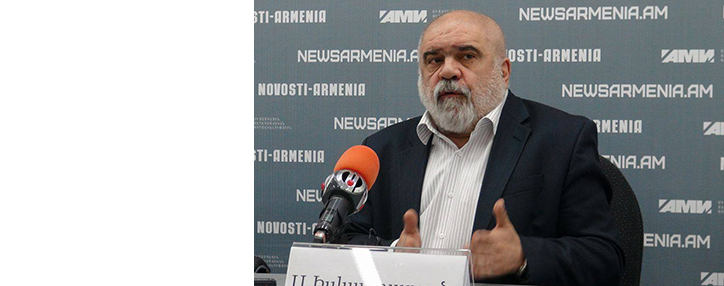
YEREVAN, July 21. /ARKA/. Election of Bako Sahakyan as president of Artsakh (Karabakh) has had no impacts on things on the line of contact between Karabakh and Azerbaijani armed forces, Alexander Iskandaryan, a political analyst and the director of the Caucasus Institute, told reporters on Friday.
On July 19 at a special session of the National Assembly of Artsakh, Bako Sahakyan, Artsakh president, was re-elected.
"What is going on the contact line is Azerbaijan’s decision, which was made not today and not yesterday,», Iskandaryan said. «This is a strategy – to trigger tension on the border. Azerbaijan refrains from large-scale ventures, but it also doesn't consider negotiation as solution to the problem. This gives grounds for thinking that things on the border will remain unchanged.»
Commenting on the re-election of the present president of Artsakh, Iskandaryan said that sense of danger in the republic requires consolidation, and the Artsakh elite, taking this into account and guided by local objectives, has taken this step.
«I don't think the conflict can be settled soon,» the political analyst said. «Azerbaijan is putting pressure upon the Armneian sides. This is its strategy. Now Azerbaijan looks like Egypt under Mubarak's rule, or Libya at a period of Gaddafi's presidency.»
Karabakh conflict broke out in 1988 when Karabakh, mainly populated by Armenians, declared its independence from Azerbaijan.
On December 10, 1991, a few days after the collapse of the Soviet Union, a referendum took place in Nagorno-Karabakh, and the majority of the population (99.89%) voted for secession from Azerbaijan.
Afterwards, large-scale military operations began. As a result, Azerbaijan lost control over Nagorno-Karabakh and the seven regions adjacent to it.
Some 30,000 people were killed in this war and about one million people fled their homes.
On May 12, 1994, the Bishkek cease-fire agreement put an end to the military operations.
Since 1992, talks brokered by OSCE Minsk Group are being held over peaceful settlement of the conflict. The group is co-chaired by USA, Russia and France. -0---